
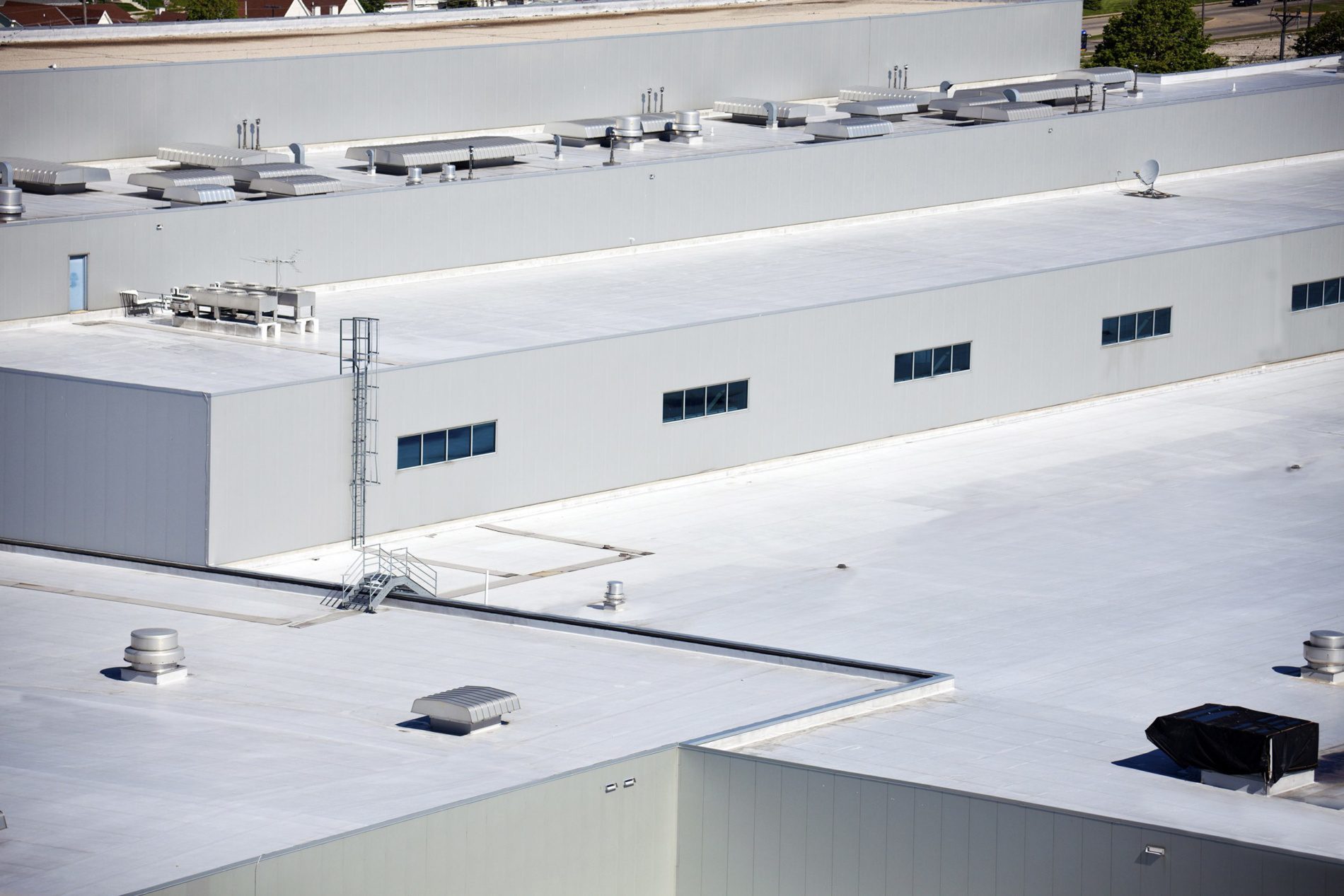
Commercial roofing for retail centers, strip malls, big-box stores, and shopping destinations.
Wichita's retail market is led by the major corridors along East Kellogg Avenue, the Rock Road retail spine from 21st Street southward, and the concentrated power centers around Greenwich Road and 21st, where the city's growth has pushed significant new retail development. The established neighborhood centers in the College Hill and Delano areas, the big-box retail flanking the East Kellogg Avenue artery, and the strip centers threading through Andover and Derby's growing commercial zones all face a Southern Plains climate that delivers every roofing challenge at amplified scale: 100-degree summers, ice storms that can coat every surface in two inches of freezing rain, hail events that regularly make national storm records, and the wind loads that come with sitting in the heart of the Great Plains.
Hail is the defining weather risk for Wichita commercial retail roofs, and the insurance implications shape how property owners approach roofing decisions. Sedgwick County sits in the statistical core of North America's hail belt, and golf-ball-size hail events are not anomalies here, they're a recurring feature of late spring and early summer weather. TPO membranes in 60-mil thickness withstand most hail events without puncture, but 80-mil installations provide meaningfully better resistance to large hailstones and are specified for anchor tenant pads and buildings where interior inventory would be severely damaged by a leak from a hail puncture. Hail-resistant classification ratings from FM Approvals and UL are tracked product attributes in this market, not footnotes.
Wind uplift on Wichita retail roofs requires engineering based on the actual wind speeds and exposure categories applicable to open suburban commercial sites on the Kansas plains. The East Kellogg Avenue and Greenwich Road power centers are essentially open terrain with no surrounding structures to reduce wind exposure, which means fastening patterns cannot be borrowed from projects sited in dense urban environments. We calculate ASCE 7 uplift pressures for each project's specific site exposure category and specify fastener spacing and cover board requirements accordingly. Edge metal and parapet cap detail design also reflects the higher design wind speeds applicable to this region.
Ice storm damage is less discussed than hail in Wichita roofing conversations, but it is a significant threat to older retail buildings. The January and February freezing rain events that periodically encase the entire metro in ice create roof loads that exceed snow load calculations because ice is considerably denser than snow. The 2023 ice storm that struck South-Central Kansas left several older commercial buildings with structural damage traceable to accumulated ice load. We assess older retail buildings' structural decks before any re-roofing project and flag buildings where ice storm loading combined with new roofing material weight creates potential structural margin concerns.
Flat roof drainage on Wichita retail buildings must account for the region's intense convective storms. The 15-minute, 10-year rainfall intensity for Wichita is high enough that drain sizing based on average annual precipitation significantly undersizes the drainage capacity needed to handle peak flow events. We size primary drains based on the applicable Wichita design storm data and specify emergency overflow provisions using scuppers or secondary drain systems sized to handle the remainder of the design storm flow without exceeding the structural capacity of the roof assembly. The Rock Road retail corridor sits over relatively flat terrain without natural drainage channels, making engineered roof drainage the only defense against ponding accumulation in heavy rain events.
The concentration of national retail brands in Wichita's power centers, anchors including major grocery, home improvement, and warehouse club operators at properties like Bradley Fair and the East Kellogg corridor, means facilities management relationships with national tenant property teams are an operational reality, not an occasional project need. National tenants' facilities groups conduct periodic audits of landlord-maintained roofing systems, and the documentation those audits require includes installer certifications, manufacturer warranty status letters, and recent inspection reports. We maintain the manufacturer certification status and documentation practices that make those audits routine rather than disruptive to landlord-tenant relationships.
Energy costs in Kansas retail are meaningful, with cooling costs running May through September and heating costs adding a substantial winter component to operating expenses. TPO reflective membranes reduce cooling loads, but the insulation upgrade opportunity in a Wichita retail re-roofing project deserves equal attention for heating cost impact. Polyisocyanurate insulation achieving R-25 or better, which most roof replacements on older strip centers can accommodate by adding inches of cover board, reduces heating energy consumption during Wichita's cold season in ways that a membrane upgrade alone cannot. We present the energy analysis alongside the roofing proposal for property owners making full-replacement decisions.
Rooftop HVAC equipment density on Wichita strip centers reflects the retail mix along corridors like the East Harry Street retail district and the South Seneca commercial areas: salon and personal services tenants with supplemental electric resistance heat, restaurant tenants with kitchen exhaust systems, and the base HVAC equipment covering every retail bay. Each tenant improvement cycle that adds mechanical equipment needs a new penetration detail, and those details accumulate over a building's life until the roof looks like a crowded skyline of curbs, pipes, and conduit runs. We photograph and document every existing penetration during pre-project surveys and incorporate penetration consolidation recommendations into our replacement proposals when opportunities exist to reduce the total penetration count through equipment reconfiguration.
Wichita's retail construction market is active enough that qualified roofing contractors are in consistent demand, and project scheduling lead time matters for property owners planning capital improvements. We recommend engaging our project estimating team at least four to six months before the desired project start date for projects larger than 20,000 square feet, particularly if the project involves a national tenant's required installation window or a specific lease commencement date. Emergency replacement capacity is maintained year-round, but planned projects executed on appropriate timelines allow for design optimization, material procurement without expediting premiums, and crew scheduling that delivers experienced installation teams rather than whoever is available at the last minute.
Roof questions this work should answer
Where is the roof vulnerable?
Drainage, seams, curbs, edge metal, penetrations, traffic paths, and prior repairs should be clear enough to guide the next step.
What has to happen first?
Active water entry, tenant protection, safe access, and storm documentation are handled before long-range pricing is finalized.
How should ownership compare options?
Repair, coating, recover, and replacement choices should be compared against roof age, wet insulation, building use, and the cost of future disruption.