
Roofing for Wichita's Airport and Aviation Facilities
Wichita calls itself the Air Capital of the World, and it earns the name. Spirit AeroSystems, Textron Aviation, Cessna, Beechcraft, and Bombardier Learjet build aircraft here; McConnell Air Force Base flies the KC-46A tanker on the city's southeast side; and Wichita Dwight D. Eisenhower National Airport (ICT) moves passengers around the clock. Roofing any of these facilities has nothing in common with putting a membrane on a strip mall. The buildings are enormous, the roofs are punished by wind and jet exhaust, and the operation underneath never stops to make room for a roofing crew.
Why an Aviation Roof Is a Different Job
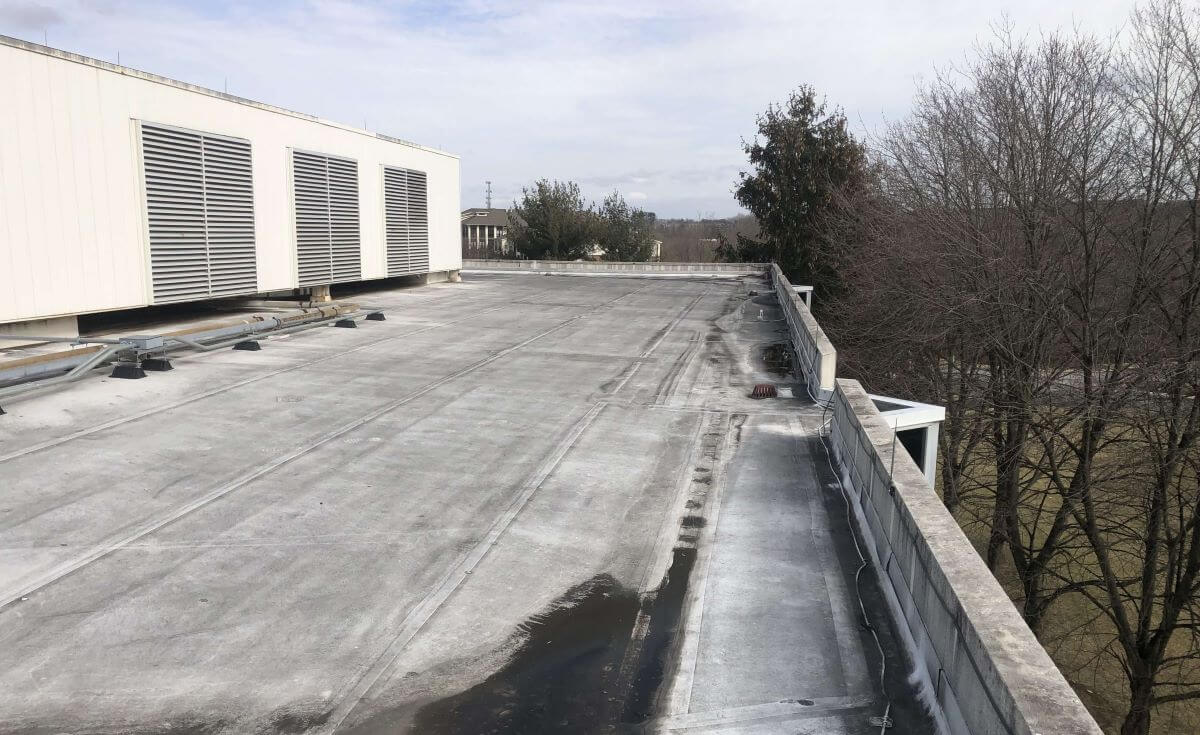
Terminal and hangar roofs cover acres in a single membrane field, usually at minimal slope. On a roof that large, drainage design is everything and the tolerance for ponding is essentially zero, a low spot that would dry harmlessly on a small building holds water for days and shortens the membrane's life across a huge area. We design tapered insulation to move water decisively to the drains and we treat every internal drain and overflow as a detail that has to perform, because there is no margin to absorb a slow leak over occupied gate areas or aircraft on the floor below.
Wichita sits in open country where straight-line winds and the storms that cross the plains drive serious uplift, and airside roofs add jet blast on top of the weather. Exhaust from taxiing aircraft hits perimeter and airside roof areas with forces a logistics building never sees. We specify membrane adhesion, fastening, and ballast or edge-securement to exceed standard commercial uplift ratings in those zones, and we pay particular attention to the corners and perimeters where both wind and jet blast concentrate.
Terminal HVAC is heavier and more crowded than ordinary commercial, large air handlers, exhaust, and equipment serving high-occupancy concourses mean a high count of curbed penetrations and more flashing to maintain. We survey and document every curb, height, and clearance before building the work plan, and we engineer flashing for oversized equipment curbs and complex through-penetrations individually rather than forcing standard details onto them.
Working at an Operational Airport
Scheduling at ICT means working with the airport facilities department and the Part 139 coordinator on a phased plan that airport operations approves. Material deliveries, crane lifts, and any work near airside areas happen in approved windows, coordinated with the NOTAM process where required. Airside work demands badged, credentialed crews, and we do not put anyone on an airside roof without confirmed authorization, that is a baseline we enforce, and the credentialing timeline is built into the bid, never discovered onsite. Because terminals operate 24/7, dry-in discipline is absolute: the work area is watertight at the end of every shift, over travelers and operations that continue all night.
Aviation campuses are full of buildings that are not the terminal but still sit inside the security and coordination envelope, cargo facilities, rental-car centers, FBO terminals, and aircraft maintenance buildings. The building types vary, but badging and access planning never go away, and our crews treat it that way. High-bay hangars are their own specialty: wide clear-span steel or pre-engineered structures whose uplift and thermal movement behave differently than a flat commercial deck. For those we specify standing-seam metal or single-ply systems with fastening and seam geometry matched to the structure, both at the airport and at general-aviation fields around the region.
Hail, Storm Response, and the Insurance File
Wichita sits squarely in hail country, and the storms that roll across the plains in spring put aviation roofs in a tough spot. A large hail event can bruise or fracture a single-ply field across acres of terminal or hangar roof in a matter of minutes, and on a building that operates 24/7 there is no luxury of waiting weeks to respond. We handle storm damage on aviation facilities as an emergency-and-documentation problem at the same time: temporary watertight repairs go in fast to protect gate areas, baggage systems, and aircraft below, while we photograph and map the damage in the detail an insurer and an FAA-regulated owner both require. For hail-prone facilities we also talk through impact-resistant membrane choices and ballast or cover-board strategies up front, so the next storm does less damage than the last one. Because these roofs are so large, a methodical zone-by-zone inspection after every major storm catches bruising before it becomes a leak, far cheaper than discovering saturated insulation a season later. That same documentation discipline feeds the asset-management and capital-planning files these large public and quasi-public facilities run on.
Membrane Choices for Aviation Roofs
Most terminal re-roofing here uses a TPO or PVC single-ply over a tapered insulation system built to solve drainage and ponding. New high-bay hangars and aviation support buildings often call for standing-seam metal. The right system depends on the existing deck, its load capacity, and the operational constraints, we develop the specification after walking the roof with the facility's engineer, not from a catalog.
- Acre-scale low-slope fields drained with tapered insulation and zero ponding tolerance
- Uplift- and jet-blast-rated securement at airside perimeters and corners
- Every curb and penetration surveyed and flashed individually
- Phased plans coordinated with airport facilities, FAA Part 139, and the NOTAM process
- Badged, credentialed crews for airside work with the timeline built into the bid
- Standing-seam and single-ply options for high-bay hangars and FBO buildings
Talk to a Wichita Aviation Roofing Crew
From a terminal re-roof to a hangar at a reliever field, we will walk the building with your facilities engineer, work out the operational and security plan, and give you a specification matched to the wind, the scale, and the schedule an airport demands. Reach out to start the conversation anywhere in the Wichita area.
Roof questions this work should answer
Where is the roof vulnerable?
Drainage, seams, curbs, edge metal, penetrations, traffic paths, and prior repairs should be clear enough to guide the next step.
What has to happen first?
Active water entry, tenant protection, safe access, and storm documentation are handled before long-range pricing is finalized.
How should ownership compare options?
Repair, coating, recover, and replacement choices should be compared against roof age, wet insulation, building use, and the cost of future disruption.